


Butcher's Crossing
 This is an exciting and well-written novel, setting the viscous brutality and gentle kindness of men against the backdrop of a vivid, nostalgic depiction of the American West. The aspects of human nature which Williams chooses to contrast are counterbalanced by the opposing forces in the wild lands of the frontier he describes. The ambitions and follies of men play out against a nature which is at once movingly beautiful and harshly indifferent - a country of inner truth and stark emptiness, reflected in the eyes of the men who seek to explore and dominate it.
Williams sketches the characters and dialog in direct, sparse terms; the blend recalls both gritty westerns as well as some of my favorite passages of Hemingway. Unlike works from the latter author, however, I was not drawn into the internal life of these characters in any meaningful way, and this is my one complaint. On the whole, the story and writing are potent enough to carry the novel strongly through to the end regardless.
My thanks to NPR's Three Books series for suggesting this novel in their episode Three Books to Take to a Fistfight. It certainly lived up to the recommendation.

Dreams from My Father: A Story of Race and Inheritance
 Great material and interesting, but overall told from too detached a point of view. Many times I was left with the impression: "Well that was interesting, but so what? What does it mean - emotionally, socially, and politically?" It's a great set of experiences but its not really tied into a cohesive story. Definitely enjoyed it and have saved some excellent quotes from it, particularly the passages that deal with growing up having a bisected cultural identity. I do plan to read "The Audacity of Hope" at some point.

Two Gentlemen of Lebowski: A Most Excellent Comedie and Tragical Romance
 Easily one of the funniest books I have ever read.

The Sun Also Rises
 I do not presume that my thoughts would add anything meaningful to the volumes of commentary written about this book. I will simply say that I love Hemingway's sparse, understated style. It's like reading a play. Let the dialog speak for itself. Describe only when you have something useful or poignant to convey.
 And here are my favorite quotes from the book.
"It's awfully easy to be hard-boiled about everything in the daytime, but at night it is another thing."
"'Listen, Robert, going to another country doesn't make any difference. I've tried all that. You can't get away from yourself by moving from one place to another. There's nothing to that.'"
"'This wine is too good for toast-drinking, my dear. You don't want to mix emotions up with a wine like that. You lose the taste.'"
"'Simple exchange of values. You give them money. They give you a stuffed dog.'"
"That was morality; things that made you disgusted afterward. No, that must be immorality. That was a large statement."
"How did you go bankrupt?" Bill asked.
"Two ways," Mike said. "Gradually and then suddenly."
"You know I feel rather damn good, Jake."
"You should."
"You know it makes one feel rather good deciding not to be a bitch."
"Yes."
"It’s sort of what we have instead of God."
"I drank a bottle for wine for company. It was a Château Margaux. It was pleasant to be drinking slowly and to be tasting the wine and to be drinking alone. A bottle of wine was good company."
"It’s funny," I said. "It’s very funny. And it’s a lot of fun, too, to be in love."
"Do you think so?" her eyes looked flat again.
"I don’t mean fun that way. In a way it’s an enjoyable feeling."
"No," she said. "I think it’s hell on earth."
"Utilize a little, brother," he handed me the bottle. "Let us not doubt, brother. Let us not pry in to the holy mysteries of the hen-coop with simian fingers. Let us accept on faith and simply say – I want you to join with me in saying – What shall we say brother?" he pointed the drumstick at me and went on. "Let me tell you. We will say, and I for one am proud to say – and I want you to say with me, on your knees, brother. Let no man be ashamed to kneel here in the great out-of-doors. Remember the woods were God’s first temples. Let us kneel and say: ‘Don’t eat that, Lady – that’s Mencken.'"
"That seemed to handle it. That was it. Send a girl off with one man. Introduce her to another to go off with him. Now go and bring her back. And sign the wire with love. That was it all right. I went in to lunch."
"You paid some way for everything that was any good. I paid my way into enough things that I liked, so that I had a good time. Either you paid by learning about them, or by experience, or by taking chances, or by money. Enjoying living was learning to get your money's worth and knowing when you had it."
"Never once did he look up. He made it stronger that way, and did it for himself, too, as well as for her. Because he did not look up to ask if it pleased he did it all for himself inside, and it strengthened him, and yet he did it for her, too."
"Everything is on such a clear financial basis in France. It is the simplest country to live in. No one makes things complicated by becoming your friend for any obscure reason. If you want people to like you you have only to spend a little money."
"Oh Jake," Brett said, "We could have had such a damned good time together."
Ahead was a mounted policeman in khaki directing traffic. He raised his baton. The car slowed suddenly, pressing Brett against me.
Yes," I said. "Isn't it pretty to think so?"

Shooting the Stickbow
 This will be a reference I will use for a long time. Everything from equipment maintenance to form to the mental zone... absolutely essential for every traditional archer.

The Playwright's Guidebook: An Insightful Primer on the Art of Dramatic Writing
 Excellent reference. Will be keeping this one and referring back to it for a long time. It's advice on the writing process aside, from the perspective of a director who works with original material quite often, it is highly useful to know the principles on which sound plays are built. An enjoyable and useful read.

The Gnostic Gospels
 A well-researched exploration of the differences between the original diversity of thought surrounding the teachings and sayings of Jesus, and what became the institution of mainline Christianity. I very much appreciated the author's care in investigating beyond just the differences between gnostic and catholic (in which I include post-Reformation Christianity, because in the broader sense of early Christian thought they really are not that different). She also details the political motivations for Rome and the early church in selecting which of the many gospels and writings on Jesus would make it into the official canon we now know as the New Testament.
 The systematic (and unfortunately for posterity, highly effective) process of narrowing the canon down to those of most political advantage to the new Holy Roman Empire and then brutally eliminating all differing writings and their "heretic" authors, is re-enacted in these pages by Pagels' fine writing.
The ultimate result for me personally is to find new understanding and perspective on the New Testament as well as Jesus as a philosopher and prophet; taken in the broader context of the Gnostic writings which were removed by the Council of Nicea, much of what I find unpalatable and even abhorrent about the Institution of Christianity is mitigated and, in many cases, reversed. I came away feeling very excited to learn more about Gnosticism and how it's insights (and Christianity in general) can enhance my own personal brand of spirituality.

The Gunslinger
 Absolutely beautiful. This is the novel I have been waiting my entire life to read. Can't wait to get to the rest of the series.

Writing Science Fiction & Fantasy
 Great principles to use as a foundation, but some of the perspectives and state of scientific knowledge are a bit dated.

The Wind in the Willows
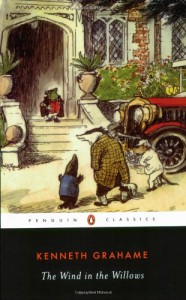 I have vague memories of the animated movie; fleeting images come to mind that seem mostly centered on being frightened at the crazed look in Mr. Toad’s eyes as he wildly careens down the road reveling in his addiction, the speed of his motor-car. Yet when I came across The Wind in the Willows while browsing the Barnes and Noble Classics series on my Nook, it occurred to me with a start that I had never actually read this classic set of bedtime stories, written by Kenneth Grahame for his son. I expected a quick read that would do little more than check an as-of-yet-overlooked box.
Perhaps I simply did not understand the many-layered beauty of the story as a child, or maybe I was too frightened of Mr. Toad at whatever age it was that I saw the movie to remember anything else, or maybe the film was not really up to the task of conveying what I now find exquisite about this work of children’s literature. I suspect a combination of all three. What I can say is, that I have emerged from reading this book straight through as one wakes from a pleasant dream.
Sudden and magnificent, the sun’s broad golden disc showed itself over the horizon facing them; and the first rays, shooting across the level water-meadows, took the animals full in the eyes and dazzled them. When they were able to look once more, the Vision had vanished, and the air was full of the carol of birds that hailed the dawn [108:].
Grahame uses evocative and flowing language, always centered on the natural world and the importance of its connection and rhythms. The animals’ intuitive closeness with their surroundings form the backdrop of a series of adventures by the protagonist Mole and his friends, Water Rat, Badger, and Toad. As improbable and silly as the plot turns often were, I found myself willingly suspending disbelief in exchange for the privilege of absorbing more of the beautiful expressions as fast as I could:
Their old haunts greeted them again in other raiment, as if they had slipped away and put on this pure new apparel and come quietly back, smiling as they shyly waited to see if they would be recognized again under it [105:].
Interspersed with the lovely, poetic dialog of nature and animals are insightful remarks on human society and behavior. These run not only along the lines of commentary on mankind’s impermanence upon the backdrop of the world – “ ‘Who can tell?,’ said the Badger. ‘People come – they stay for a while, they flourish, they build – and they go. It is their way. But we remain.’” [73:] – but also in caricature of very human types.
Mole’s naïve, wide-eyed view of the world; Water Rat’s moody, poetic musings and sharp cunning; the earthy, country simplicity of Badger’s generosity and strength; Toad’s outrageously inflated conceitedness, masking affable charm and landed refinement – in these portraits we easily find parts of ourselves, shades of others we know, and perhaps a bit of who we aspire to be. I have, I admit, perhaps a bit more of Toad in me than I’d like; but I still connected most eagerly with the Rats – both the major character of Water Rat, as well as in the following urging by a lesser character, the Sea Rat:
Take the Adventure, heed the call, now ere the irrevocable moment passes! ‘Tis but a banging of the door behind you, a blithesome step forward, and you are out of the old life and into the new! Then some day, some day long hence, jog home here if you will, when the cup has been drained and the play has been played, and sit down by your quiet river with a store of goodly memories for company [135:].
There is even a gem for actors, composed as succinctly as Boleslavsky might have done in admonishing his Creature to strive for “[…:] that happy grace which is the last thing the skilled actor shall capture – the natural grace which goes with perfect unconsciousness of observation” [77:].
If you did read this book as a child, I must say I envy you a bit; I would love to know how I would have perceived it had I read it without whatever present perspective I have. If you have not, please do yourself a favor and track down a copy. Even if you did read it as a child, read it again, for the sake of what insights you may have missed in your younger years.
Having now read this book and written this review all in one sitting, I am tempted to either read or write again immediately. But I think shall instead yield to Mole’s ways in this instance, pause to simply reflect on life: “[…:] and with his ear to the reed-stems he caught, at intervals, something of what the wind went whispering so constantly among them” [18:].
What a marvelous book. Maybe I just read it in a good mood or read way too much into it, but I make no hesitation in giving it a full five-star rating.

Brooklyn
 "Brooklyn" is a beautiful novel by Colm Tóibín that explores broadly human themes in a well-portrayed specific setting. When Ellis, a young Irish girl, leaves her home town of Enniscorthy for the wide world of New York in America, she is awkward, wide-eyed, and ill-prepared for what greets her on the other side of the Atlantic. When she returns to visit years later in the wake a family tragedy, her nostalgia for the past and perspective on the present are both shaken.
 This novel will connect with any of those who have left home, be it for university, a job, or a loved one, to the next town over or to a far-off country with foreign customs and people. After such a move, there is a strange, sad, yet beautiful feeling that comes when you visit the place of your growing up after many years, and realize that it and you have changed, and changed separately. That simultaneous rush of fear and excitement, loss and opportunity, memory and expectation, is captured honestly in this novel.
I consider this novel well-worth reading. If you have a Nook, let me know, I would be happy to eLoan it to you!


The American Theatre Reader: Essays and Conversations from American Theatre magazine
 This is now the de facto bible of artistic philosophy for my theatre company.
 Not all of it is wholly understandable, in-line with what I think is right, or necessarily applicable to many of the practical challenges we face; it is, however, full of brilliant writing that inspires and offers poignant examples of issues that should be considered and reflected upon carefully.
Sort of, you know, like that other bible.
Love it.

Child 44
 Tom Rob Smith's "Child 44" is a stark thriller set in Soviet Russia. While the plot is engaging and the psychological concept intriguing, I found myself wishing for some more depth. Like most thrillers, the personalities are for the most part fairly two-dimensional; interesting shockers about their respective pasts are revealed through clever plot devices rather than any particular depth of character. The dialog is effective, but terse and unadorned, serving primarily to move the plot along.
 By far, the most engaging part of this novel was the depiction of the hardship and fear present in daily life under the Stalinist state machine; the transformation of the protagonist from one wholly loyal to this system into one profoundly disgusted with its human implications is interesting to observe. The final showdown (and any thriller worth anything must have a final showdown) makes an attempt at exploring deeper issues; but while it checks all the boxes for what constitutes a final showdown, I found it to be ultimately rather anti-climatic.
This novel is an fairly entertaining, mildly suspenseful, predictable, but worthwhile distraction for a couple late nights in the library... and not much more.


Siddhartha
 I grew up learning Buddhist philosophy and religion as part of my culture. While the core principles of the religion are excellent and continue to strongly affect my personal philosophy today, I could never shake the nagging feeling that Buddhism was coldly detached, academic, and borderline nihilist.
 I have been lukewarm about reading this book, despite stellar reviews from friends; in my preconception it was more of the same, possibly even worse as a westernized watering-down of the core beliefs.
I stand corrected. "Siddhartha" is the best capturing of what I have always sensed is there in the essence of Buddhism that I have ever come across. It is Buddhism stripped of its ritual decorations and laid bare at a very human level. Five stars, and highly recommended to any Buddhist or philosophically-minded non-Buddhist.
